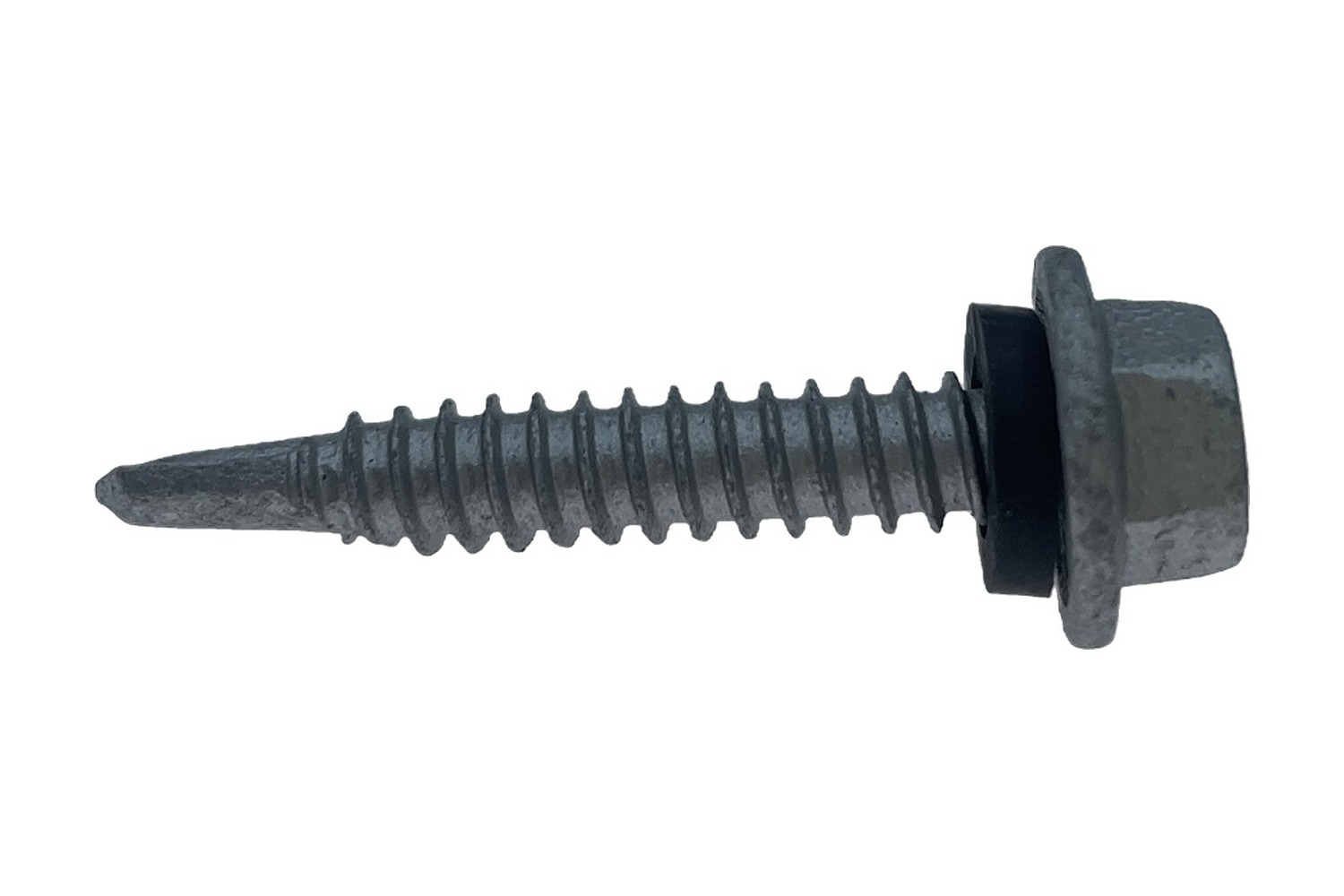
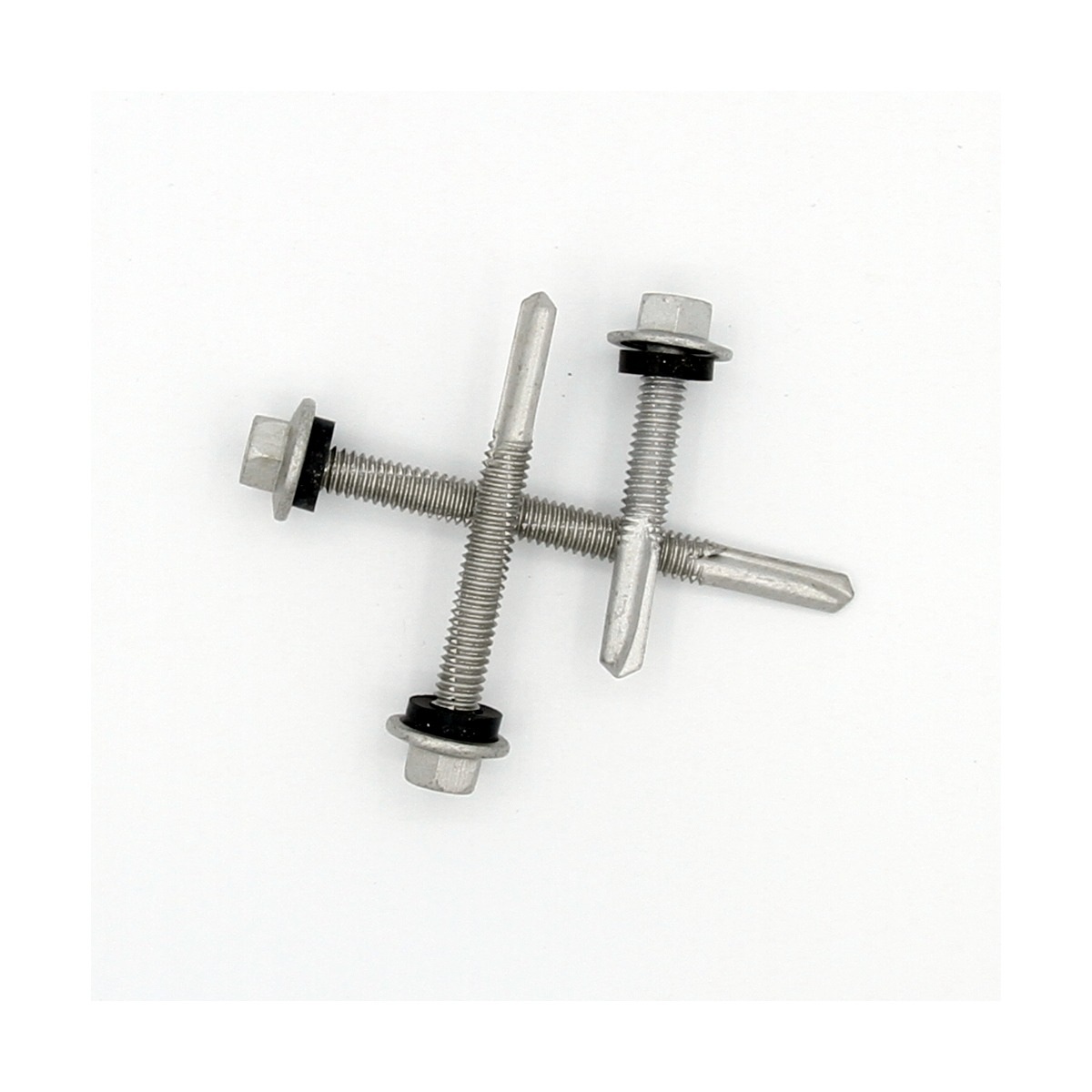
A self-drilling screw is specified by diameter, length and drill point. Everything else - coating, head, washer - is selected after those three are right. Get them wrong and no amount of coating quality will save the fixing.
The drill point is the small tapered tip that drills the hole before the thread engages. Its size determines the maximum total steel thickness it can pass through in one operation.
| Drill point | Typical capacity | Used for |
|---|---|---|
| No. 1 | up to about 1.6 mm | thin sheet, light cladding |
| No. 2 | up to about 2.0 mm | 0.5-1.0 mm sheet to thin purlin |
| No. 3 | up to about 5.8 mm | sheet plus standard purlin |
| No. 5 | up to about 12.5 mm | heavy purlin, thick built-up sections |
Two failure modes follow a mismatch. If the point is too small, the operator pushes harder, the tip overheats, the coating burns and the point dulls - the screw either stalls or breaks. If the point is too large for thin sheet, the hole is oversize and the thread has nothing to bite.
The length is not the sheet thickness. It is the sum of every layer the screw passes through before it reaches the purlin, plus the engagement in the purlin.
A screw that only just reaches the purlin will hold until the first wind event. A screw that is far too long will bottom out, deform the sheet and leave the washer under-compressed, which is the more common leak path.
On trapezoidal sheet, crest fixing and valley fixing are different specifications, not different habits.
A specification drawing is adequate when it states: screw diameter and length, drill point number, coating class, washer type, fixing position (crest, valley, clip, stitch), and the torque or tool setting used on site. Without the fixing position, the length cannot be verified; without the tool setting, the washer compression cannot be repeated.
The most common cause of site failure is not the screw - it is the driver. Recommended practice is a consistent tool setting: roughly 1,600-2,500 rpm, 400-600 W, and light axial pressure of about 15-25 kg. The screw should be driven perpendicular to the sheet, and pressure should be released once the point has drilled through, letting the thread form and seat the washer naturally.
A washer that is visibly flattened beyond its original thickness has been over-driven. A washer that still shows a gap has not been compressed enough to seal. Both are visible in a five-second inspection, which makes them the cheapest quality check on the roof.
Product-family examples. Confirm the offered configuration and supporting documents before approval.